\nEXPLORING THE VIOLENCE OF PROPAGANDA<\/em>
\nMay 12-14, 2017<\/p>\n
Princeton University<\/p>\n
In July 1942, in the middle of the Nazi advancement in the Soviet Union, Ilya Ehrenburg, one of the most cosmopolitan Soviet writers, addressed Soviet soldiers through the Soviet military newspaper Krasnaia Zvezda<\/em> (Red Star). In the preceding decades, Ehrenburg became famous for his whimsical dispatches from Paris and Berlin. This time, his address was unambiguously titled \u201cKill\u00a0them!\u201d, appealing:<\/em><\/p>\n We know everything. We remember everything. We understand it now: Germans are not people\u2026 Enough of talking. Enough of outrage. Now, it\u2019s time to kill. \u2026Stop counting days. Stop counting miles. Count only the Germans you\u2019ve killed\u2026 Do not fail to hit. Do not miss the target. Kill!<\/em><\/p><\/blockquote>\n Propaganda has always been a crucial part of war. Mobilizing through polarization, distortion and simplification, it helped to produce an effect of ideological cohesion and social solidarity, which, in turn, often resulted in disastrous military conflicts: be it the wars in Yugoslavia in the 1990s, the Iraq war of the last decade, or the current wars in Ukraine and Syria (to name just a few). The program committee of this conference invites historically, ethnographically and theoretically grounded contributions that explore the role of propaganda in unleashing and framing military conflicts of the last century.<\/p>\n This conference makes an attempt to go beyond<\/em> descriptive representations of violent narratives, and to explore instead internal mechanisms and external effects of war propaganda. How wars are translated and transposed into such fields of cultural production as music, dance, architecture, and\/or performing arts? How is the mobilizing effect achieved in these different fields? How do these fields envision their target audience? How do media and social networks create their own ways of disseminating war accounts and in galvanizing their audience? Does the private consumption of Youtube videos make this medium significantly different from more traditional propaganda newsreels? Are Facebook postings qualitatively distinct from propaganda flyers or, say, Ehrenburg\u2019s address?<\/p>\n As recent studies of war propaganda and hate speech have shown, much of the affective efficacy of We look for participants who analyze rhetorical tools, narrative strategies, and visual devices that recharge historical records with new affective power. In particular, we welcome submissions that demonstrate how historical documents have been used, adapted, transformed and modified (visually, sonically, chronologically, etc.) by mass media not only for constructing and conveying their propaganda messages but also for turning these documents into technologically advanced and emotionally appealing artifacts.<\/p>\n The Program Committee:<\/p>\n Serguei Oushakine<\/strong><\/a>, Chair<\/em> (Princeton) The annual conference<\/a> is organized by the Program in Russian, East European, and Eurasian Studies<\/a> and made possible by the generous funding from\u00a0the Princeton Institute for International and Regional Studies.<\/p>\n","protected":false},"excerpt":{"rendered":" An Annual Interdisciplinary Conference WAR FRENZY: EXPLORING THE VIOLENCE OF PROPAGANDA May 12-14, 2017 Princeton University In July 1942, in the middle of the Nazi advancement in the Soviet Union, Ilya Ehrenburg, one of the most cosmopolitan Soviet writers, addressed Soviet soldiers through the Soviet military newspaper Krasnaia Zvezda (Red Star). In the preceding decades, … Continue reading “About the Conference”<\/span><\/a><\/p>\n","protected":false},"author":1801,"featured_media":0,"parent":0,"menu_order":0,"comment_status":"closed","ping_status":"closed","template":"","meta":{"inline_featured_image":false,"_coblocks_attr":"","_coblocks_dimensions":"","_coblocks_responsive_height":"","_coblocks_accordion_ie_support":"","footnotes":""},"class_list":["post-10","page","type-page","status-publish","hentry"],"jetpack_sharing_enabled":true,"jetpack_shortlink":"https:\/\/wp.me\/P85oAQ-a","_links":{"self":[{"href":"https:\/\/warfrenzy.princeton.edu\/index.php?rest_route=\/wp\/v2\/pages\/10","targetHints":{"allow":["GET"]}}],"collection":[{"href":"https:\/\/warfrenzy.princeton.edu\/index.php?rest_route=\/wp\/v2\/pages"}],"about":[{"href":"https:\/\/warfrenzy.princeton.edu\/index.php?rest_route=\/wp\/v2\/types\/page"}],"author":[{"embeddable":true,"href":"https:\/\/warfrenzy.princeton.edu\/index.php?rest_route=\/wp\/v2\/users\/1801"}],"replies":[{"embeddable":true,"href":"https:\/\/warfrenzy.princeton.edu\/index.php?rest_route=%2Fwp%2Fv2%2Fcomments&post=10"}],"version-history":[{"count":18,"href":"https:\/\/warfrenzy.princeton.edu\/index.php?rest_route=\/wp\/v2\/pages\/10\/revisions"}],"predecessor-version":[{"id":198,"href":"https:\/\/warfrenzy.princeton.edu\/index.php?rest_route=\/wp\/v2\/pages\/10\/revisions\/198"}],"wp:attachment":[{"href":"https:\/\/warfrenzy.princeton.edu\/index.php?rest_route=%2Fwp%2Fv2%2Fmedia&parent=10"}],"curies":[{"name":"wp","href":"https:\/\/api.w.org\/{rel}","templated":true}]}}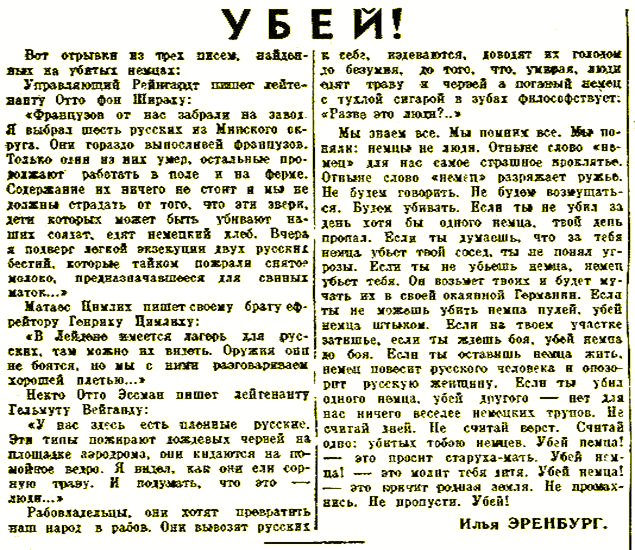 <\/a>A classic example of war propaganda, the address framed war affectively. Deploying words and images as rhetorical weapon, Ehrenburg constituted a collectivity, channeling its anger and anxiety, providing it with a clearly defined aim, and suggesting an action to take. Descriptive and prescriptive at the same time, the address interpellated its audience, transforming readers into avengers.<\/p>\n
\nthese forms of discursive mobilization hinges on their ability to convert the past into a historical justification for violence, retribution or revenge in the present. This propagandistic linking of past wars with today\u2019s conflicts is another crucial aspect that the conference\u00a0focuses on: How are historical examples of war or genocide \u201crecycled\u201d and \u201crepurposed\u201d in order to perceive new military conflicts? What are the methods of representation and types of referencing that make war history relevant? Which networks and institutions capitalize on the usable past by historicizing military invasions and conflicts?<\/p>\n
\nPeter\u00a0Fritzsche<\/strong><\/a> (University of Illinois)
\nAlexei Golubev<\/strong> <\/a>(University of Toronto)
\nJochen Hellbeck<\/strong> <\/a>(Rutgers University)
\nAlaina Lemon<\/strong><\/a> (University of Michigan)<\/p>\n